Leon from GreenSide on building products from waste, locally and socially
Leon from GreenSide shares how his initiative started, how it works in practice, and what it really takes to build products from waste in a local and social way. An honest look behind the scenes, straight from the maker himself.
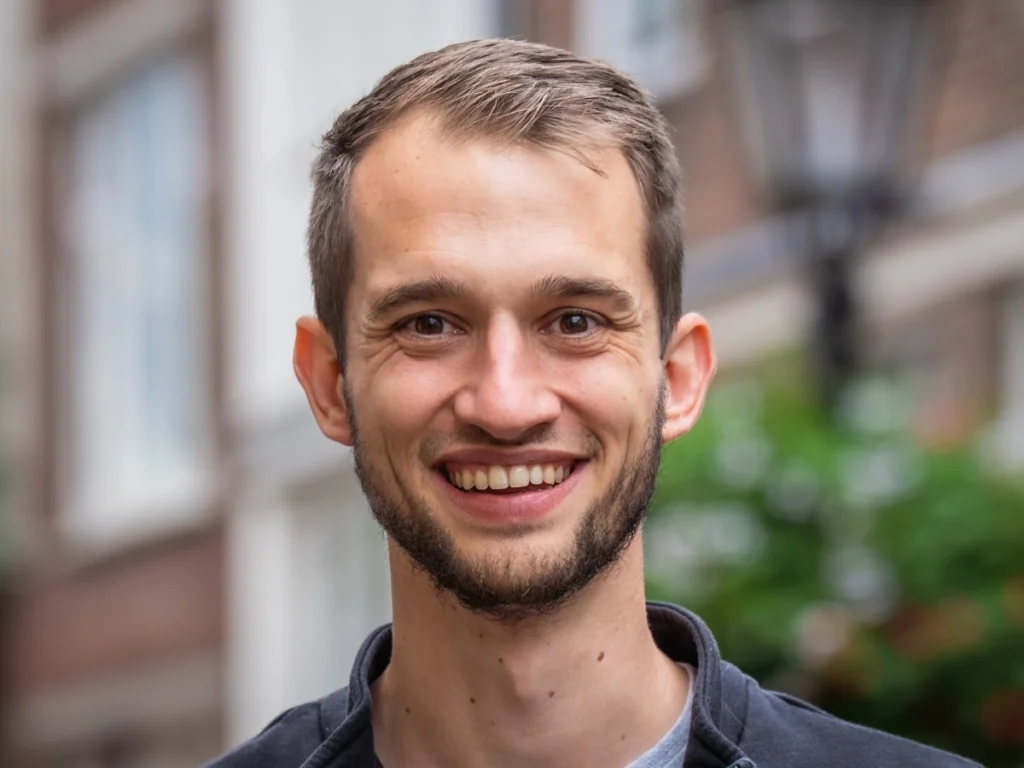
Leon Polman is the founder of Green Side. Through Green Side, he works with leftover materials to create products that are made locally, together with social workshops.
In this interview, Leon talks openly about how Green Side started, how it works in practice, and what it takes to keep a waste transformation initiative going. From small aha moments to real challenges, doubts, and decisions. An honest look behind the scenes of building something with waste as a starting point.
Léon: My name is Leon Polman, founder of Green Side, and I started it around 2018. After studying Organisation, Change and Management in Utrecht, GreenSide has grown into a company where we give leftover materials a second life in a sustainable, social, and local way.
What are the core values of Green Side?
Léon: The three core values we work with are sustainability, social impact, and local production. We very consciously choose to combine all three, to show that this is possible if you approach things differently.
Sustainable means that all our products are made from leftover materials, materials that have already been used somewhere else. Social means that we always work together with social workshops, where people with a distance to the labour market work. These are people with many talents, and we want to help them use those talents. Local means that we try to do everything within one city.
How does that local model work in practice?
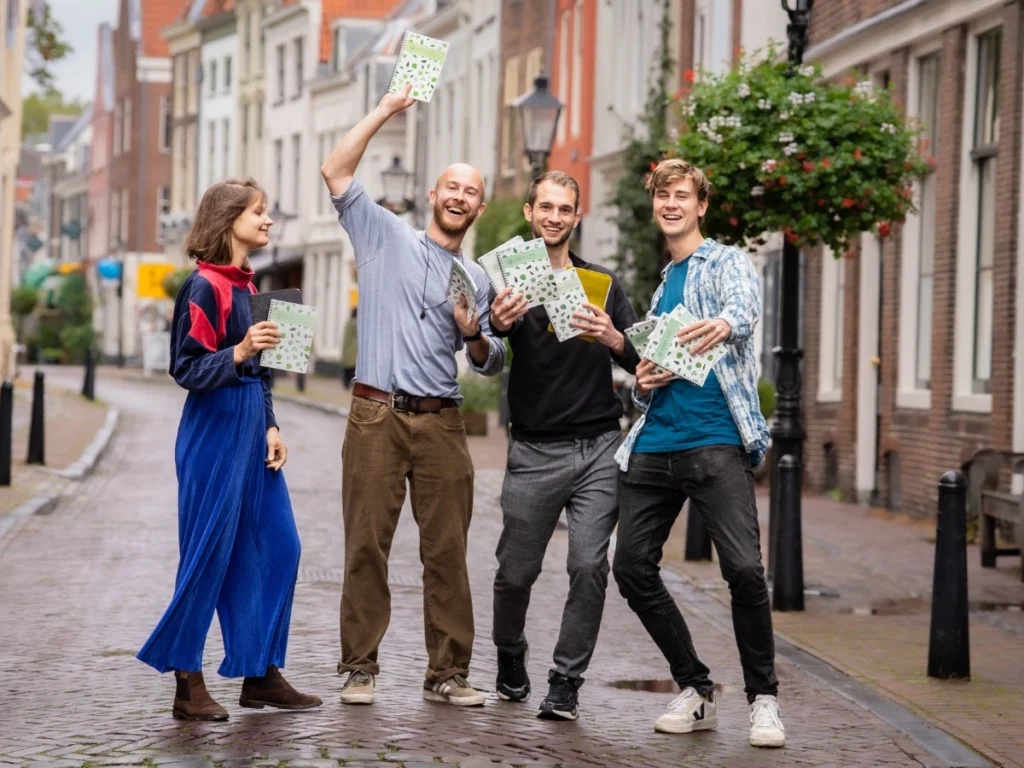
Léon: If we take our notebooks as an example, the paper is collected at primary schools here in Utrecht. It is collected by bike and brought to Stichting Wij 030, the social workshop we work with here. When the notebooks are finished, we also look for customers in Utrecht.
Our goal is to create many of these local ecosystems throughout the Netherlands, where material is collected locally, processed locally, and sold locally. That is the world we want to move towards.
How did the idea for Green Side originally start?
Léon: The idea started when I had just graduated. I was at home cleaning up stacks of papers, reports and articles that I no longer needed. After about an hour, I had a big pile of paper on my kitchen table.
I was flipping through it and thought it would be a shame to just throw everything away. I noticed that a lot of the paper was only printed on one side. On one side was a scientific article, and the other side was completely blank.
That was my aha moment. I thought: this paper is only half used. You wouldn’t throw something away that’s only half used, right?
Do you feel like Green Side is making a difference?
Léon: We strongly believe that we make a difference with Green Side, both through the products and especially through the stories we tell around them. On a larger scale, we see it in the people who buy our products and talk about them enthusiastically.
But on a smaller scale, in my own environment, I see it even more clearly. Trust me, nobody around me can throw away a piece of paper anymore without checking whether the other side can still be used.
People start looking differently at what they have at home, asking themselves what still has value. And if everyone does that just a little bit more, whether it’s paper, fabric, posters, or something else, then we really start to change things together.
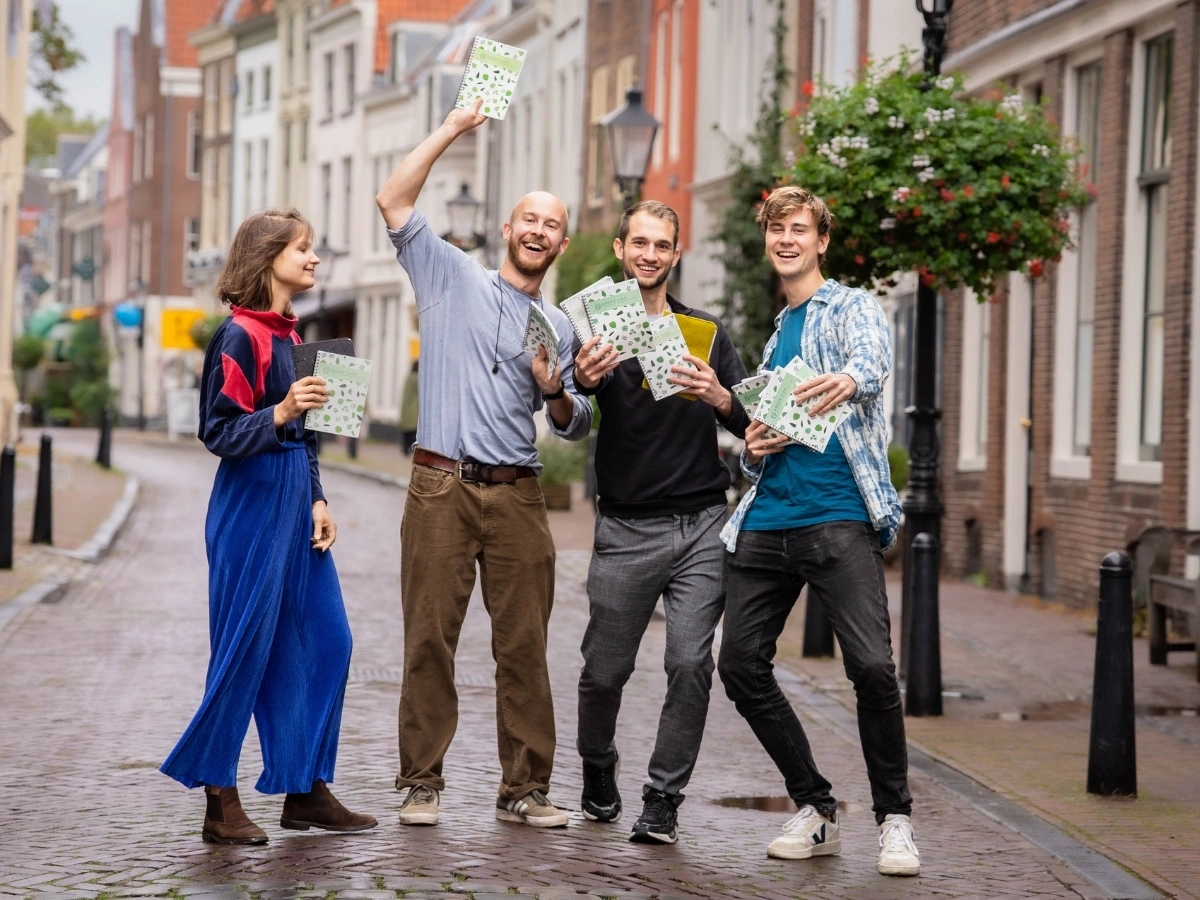
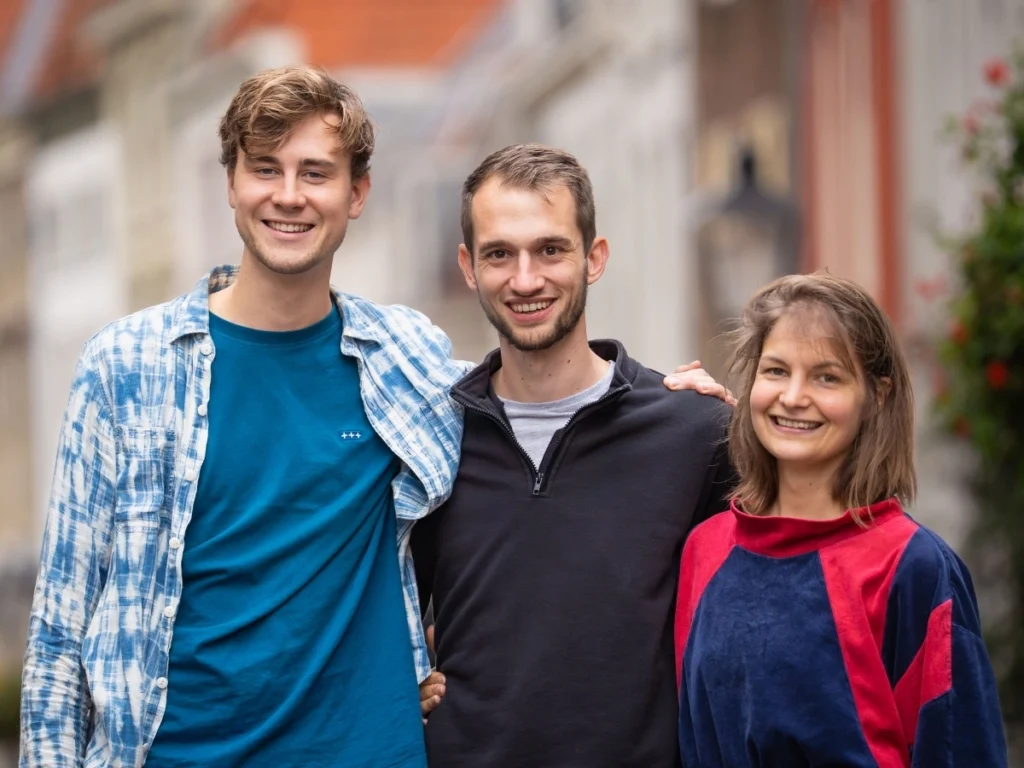
Jori Lamboo, Léon Polman and Anne-Pim van Oostveen from Green Side
Have you ever had a moment where you thought: this is too much, I’m not sure I can continue?
Léon: Oh yes, definitely. One moment that really stands out was when we delivered one of our first business orders. It was a big deal at the time: 25 notebooks, with a logo printed on the cover, delivered to a client.
Two days later, I received an email and a call saying that the paper inside the notebooks was falling out at the bottom. Everything was coming loose. They couldn’t give this to their clients.
I really sank through the floor. We had worked so hard to meet the deadline, and then it still went wrong. In the end, we refunded part of the money and added an extra quality check step in the workshop to prevent this from happening again. It’s painful, but it’s part of the journey.
What moments give you confirmation that you’re on the right path?
Léon: One moment that meant a lot to me happened at a social workshop in Houten. In the beginning, people often told me that it wouldn’t be sustainable to have everything made at social workshops and that I should automate more.
But when I walked into the workshop, people were literally pulling at my shirt, saying: “Leon, when can we make your notebooks again?” “Come and look, these notebooks are finished!” “Do you have more orders for us?”
There was so much enthusiasm, happiness, and pride. When I shared this with my colleagues, they told similar stories from other social workshops. That was a very powerful confirmation for me that this is what GreenSide stands for.
Do you ever question your own role in the system you are trying to change?
Léon: Yes, definitely. Something we think about a lot is whether we are unintentionally keeping a system alive by processing single-sided printed paper into notebooks. Sometimes I worry that it might justify people printing more, because “it will be recycled anyway”.
Ideally, we want to make ourselves obsolete by making sure there is no paper waste anymore. That’s why we also think about how we can encourage the places where we collect paper to reduce their paper use, instead of relying on us to process it.
What is your long-term vision for Green Side?
Léon: In the future, I see Green Side contributing to a world that is fully designed in a sustainable, social, and local way. Our role is to help set up local ecosystems in every city or village.
I imagine a small core team in a central place, facilitating others to create impact in their own cities. I believe real change only happens if we do it together. I would rather work with people all over the country than be one big company on an industrial estate.
My dream is a movement where people inspire others in their own environment, where someone’s grandmother shows up at a birthday party with a bag full of old paper to contribute to a local initiative.
How can people get involved or support Green Side?
Léon: If people listening or watching feel inspired and think “this should exist in my town or city”, they should definitely contact us. Our dream is to have a Green Side in every city or village in the Netherlands, where materials are collected locally, processed locally, and sold locally.
People can start their own local initiative, connect us with schools, municipalities, or thrift stores that have leftover materials, or help in many other ways. There are lots of entry points to contribute.
—
Curious to see what Green Side is all about beyond this interview?
Check out Green Side’s profile on Waste Alchemists
Explore their products made from leftover materials
See if there are workshops or events you can join
Stories like Leon’s show that waste is already being used in smarter ways. The more we support these initiatives, the easier it becomes to choose them over business as usual.
A look back at the Waste Alchemists launch event, where people met makers, created with waste, and experienced a different way of looking at this wonderful but underrated resource.
It all started with a simple student challenge and an unexpected discovery. What followed was a growing curiosity about waste, the people transforming it, and the need for a place where their stories could truly last.
We often think of waste as what ends up in our bin. But waste is created in many places we never see. When we start looking beyond our own habits, we begin to see not just a problem, but enormous potential.
Become a Waste Alchemist
Looking to become a waste alchemist? Fill out the short form for us to help you out as quickly as possible